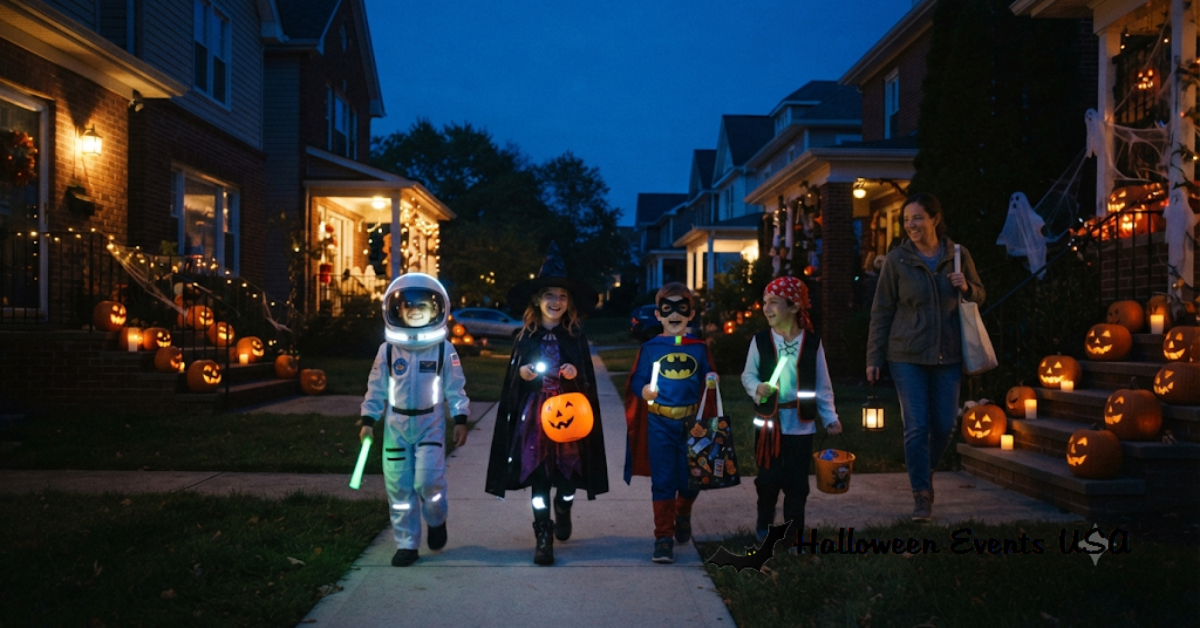
Halloween night is the one evening of the year when children walk around after dark, in costume, distracted by candy, crossing roads they usually only see from a car window. Most of the risk comes from that single sentence.
The good news is that almost every Halloween accident is preventable with a few decisions made before anyone leaves the house. This guide covers costume choices, route planning, road safety and the candy check, so you can spend the night watching your kids enjoy themselves rather than worrying about them.
Trick or Treat Safety Tips on Halloween Night
Parents tend to worry about the wrong things. The genuine dangers are not sinister strangers, they are traffic, poor visibility and children who cannot see properly out of their own masks.
Halloween evening puts more children on foot near roads than any other night of the year, and it does so at exactly the hour when drivers can see least. Everything else is secondary to that.
- Traffic: The single largest risk, especially at dusk and just after dark.
- Visibility: Dark costumes on unlit streets are close to invisible to drivers.
- Trips and falls: Long hems, oversized shoes and uneven paths cause most minor injuries.
- Costume masks: Restricted vision is a bigger hazard than most parents realize.
Costume Choices That Keep Kids Safe
The costume is the first safety decision you make, and it is usually made weeks before anyone thinks about safety at all.
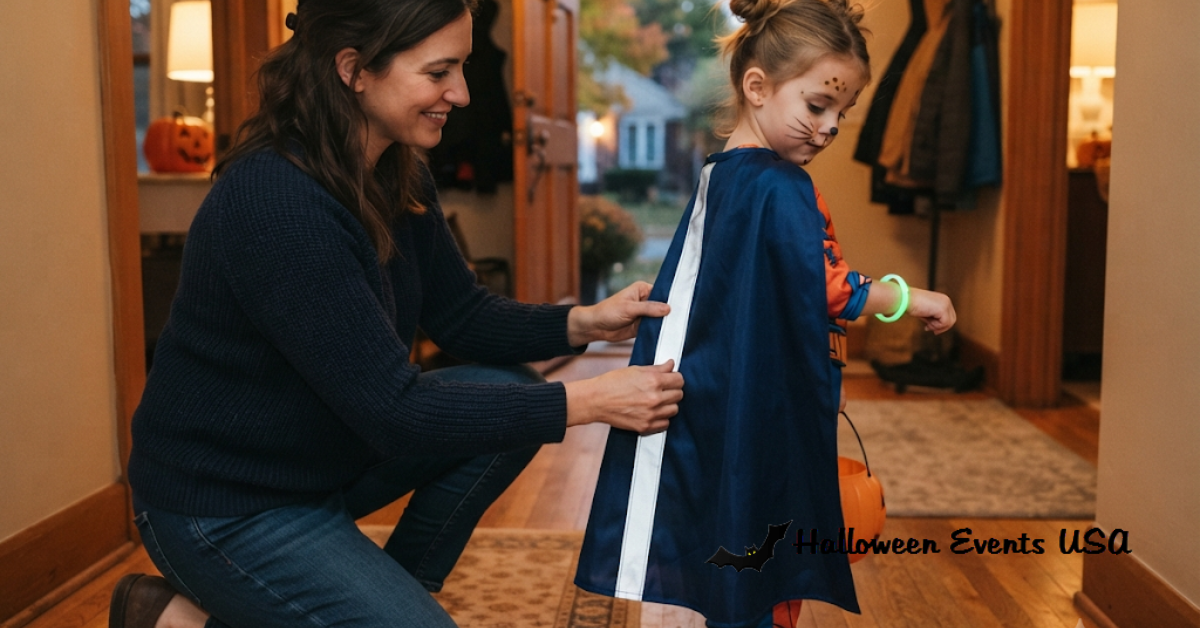
Bright colors are better than dark ones, and reflective tape costs almost nothing. A few strips along the back, arms and legs will make a child visible in headlights from far further away than a black cape ever will.
- Choose bright fabrics and add reflective tape to the front and back.
- Skip full masks and use face paint instead, since masks block side vision.
- Hem the costume so it stops above the shoe and cannot be tripped on.
- Check shoes fit properly, because oversized boots are the most common cause of falls.
- Avoid sharp props and choose flexible, blunt alternatives for swords and wands.
- Test the costume indoors before Halloween night so problems surface early.
Lighting and Visibility
If you take one thing from this guide, make it this. A child carrying a light is a child a driver can see.
Give every child in the group their own light source rather than relying on one adult with a torch. Glow sticks are cheap, they double as part of the costume, and children actually want to carry them.
- Flashlights with fresh batteries for older children.
- Glow sticks and glow bracelets for younger ones, worn rather than carried.
- Reflective trick or treat bags, or reflective tape stuck to a plain one.
- Clip-on LED lights attached to the back of a costume or a backpack.
Planning the Route
A planned route is calmer than a wandering one, and it means you always know roughly where you are and how far you have left to walk.
Stick to neighborhoods you know, streets with pavements, and houses with the porch light on. A dark house is a house that does not want visitors, and teaching children to skip those saves a lot of awkwardness.
- Walk the route in daylight first if the area is new to you.
- Stay on one side of the street and work down it rather than crossing back and forth.
- Set a finish time before you leave and tell the children what it is.
- Only approach lit houses and never go inside one.
- Agree a meeting point in case anyone gets separated from the group.
Road Safety Rules Worth Repeating
Children who trick or treat every year still forget these under the excitement of a busy street, so it is worth saying them out loud before you set off rather than assuming.
Cross at corners and crossings, never between parked cars, because a driver cannot see a small child stepping out from behind a vehicle until it is far too late.
- Look left, right and left again, even on a quiet residential street.
- Never run between parked cars or across a driveway without stopping.
- Walk, do not run, between houses.
- Make eye contact with drivers before crossing in front of a stopped car.
- Keep phones down while walking, for adults as much as children.
Age by Age Guidance
The right amount of independence depends far more on the child and the street than on a number, but there is a rough pattern most families settle into.
Children under twelve should have an adult with them. Older children going out alone need a route, a curfew and a phone that is actually charged.
- Under 5: Hold hands the entire time and keep the outing short.
- Ages 5 to 8: An adult walks with the group at all times.
- Ages 9 to 12: An adult stays on the pavement while children approach doors.
- Ages 13 and up: Independent, but with an agreed route, a curfew and a charged phone.
The Candy Check
The candy check has become a Halloween ritual, and while the horror stories are largely myth, the check is still worth doing for reasons that have nothing to do with strangers.
Feed your children a proper meal before they go out. A child who leaves the house hungry will eat unsorted candy on the pavement before you get a chance to look at any of it.
- Wait until you get home before anyone eats anything.
- Bin anything unwrapped or with a torn or opened wrapper.
- Check for choking hazards with children under four, especially hard candy and nuts.
- Read labels for allergens rather than trusting the shape of the packet.
- Set a nightly candy limit so the haul lasts a week instead of an evening.
If You Are Handing Out Candy
Half of Halloween safety happens on the other side of the door, and it costs you very little to make your house one of the safe ones.
Clear the path, light it properly, and keep the dog somewhere else. A friendly pet becomes unpredictable when forty costumed strangers knock in a single evening.
- Light your walkway and remove hoses, cords and decorations that can be tripped over.
- Use battery candles in pumpkins rather than real flames.
- Keep pets indoors and away from the front door.
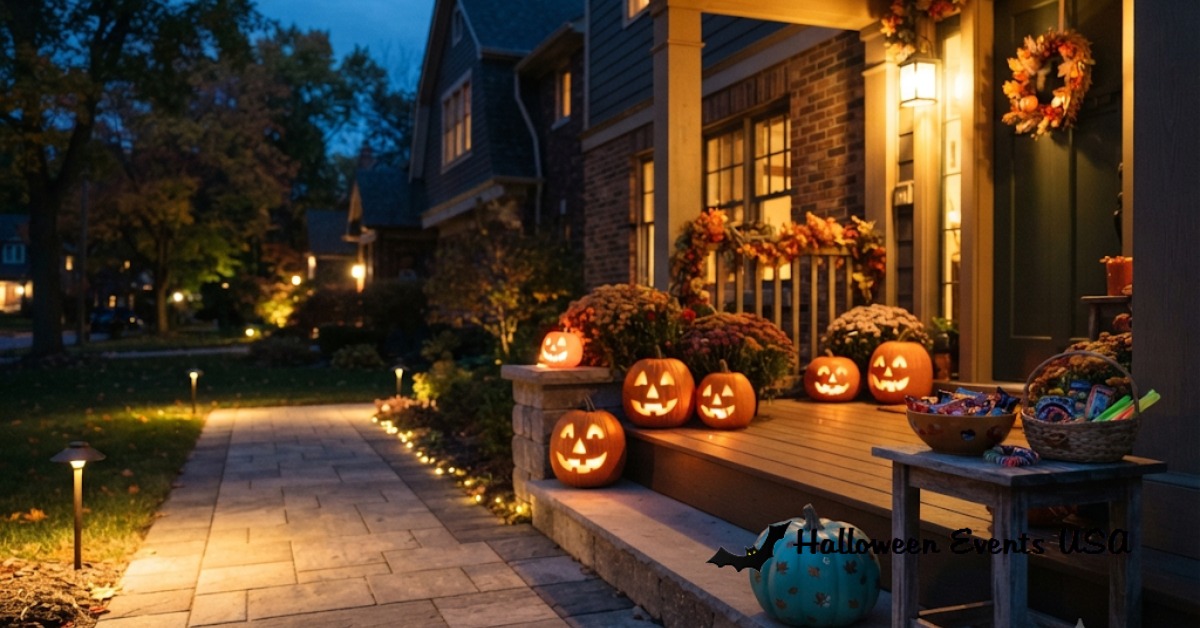
- Offer non-food treats as well and mark your house with a teal pumpkin for allergy families.
A Safe Night Is a Planned Night
Nothing on this list takes more than ten minutes to sort out. A costume you can walk in, a light in every hand, a route you already know and a meal before you leave will handle almost every risk the night contains.
Halloween Events USA brings together family friendly Halloween events, trunk or treats, carnivals and haunted attractions from across the country in one place, so you can find safe, organized events near you and enjoy the season with confidence.